
From Ancient Optics to Instant Trust: How SICPA's SKYLIGHT® Reinvents Security


Humanity's quest to understand light spans eras and cultures, from Archimedes' view of light as geometry and Alhazen's visual perception to Leonardo da Vinci's study of reflection and curved surfaces, Descartes' describing light through mathematics, and Einstein's using light to understand the universe. Together, these pioneers proved a single truth: light can be controlled, engineered, and used to reveal information.
Light is also central to public authentication, and SICPA has long exploited its interaction with materials and optical structures through technologies including OVI® and SPARK®. In its latest innovation, the company took inspiration from 'caustics' – which create the light patterns dancing at the bottom of a swimming pool – to ask a radical question: what if these patterns could carry a message?
The answer is SKYLIGHT, a new optical security feature for banknotes and identity documents that introduces a new approach to Level 1b authentication, encouraging public engagement by using a tool accessible to nearly everyone – namely the light of a smartphone (or a torch).
Developed with EPFL and Rayform, the feature projects a bright, detailed image through a transparent banknote window, turning verification into an interactive experience. It also supports quick checks by retailers and cash handlers using fixed light sources.
The technology draws on caustics – concentrated patterns of light formed through reflection and refraction, familiar as shimmering shapes on a swimming pool floor. SKYLIGHT uses a specially engineered window surface to redirect incoming light and project a miniature image onto a surface below. The image changes size and twists as it comes into focus, creating a striking effect that invites interaction.
Production combines design, computation and microfabrication. Selected images are optimised for sharpness, contrast and immediate recognition within manufacturing constraints. Advanced algorithms calculate the window surface needed to produce the image, while dedicated software simulates the result. Designers refine it iteratively until technical and aesthetic requirements are satisfied. Microfabrication then creates the tools used to cast the surface onto banknote windows.
SKYLIGHT also offers considerable design flexibility. Its freeform approach accommodates windows of different shapes and sizes, integrates with other security elements, and imposes no limitations on surrounding print or subsequent processes such as foil application. Tested images include numerals, text, portraits and animals.
Industrial-scale trials are ongoing, with qualification expanding across additional substrates and window types to support broader deployment in security applications.
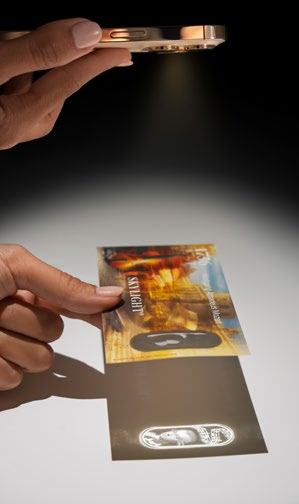
In this example, when a completely transparent window with no visible print is illuminated, its engineered microstructures precisely direct the light to project a detailed portrait of Mozart, complete with sharp lines, deep contrast, and realistic shading.
Get the Currency News™ Weekly delivered free to your inbox.