
'Beyond the Cost Debate': A Multidimensional Approach to Quantify the Value of Cash for Society


We live in an accountancy led world. Everything comes with a cost/benefit analysis, a return on capital employed percentage, net present value etc. Costs are tangible and (relatively) easy to measure. But while revenue and profit are straightforward, value is much, much harder. No wonder there are five cost-of-cash studies, primarily quantitative, for each value-of-cash study, which are largely qualitative or theoretical.
Julia Pitters (International University of Applied Science) and Franz Seitz (Technical University of Sciences Weiden) have worked with Andreas von Loeper (ICA and G+D) and Frane Maroević (ICA) on IMFS (Institute for Monetary and Financial Stability) Working Paper No 241, which was also based on workshops with other scientists – Erich Kirchler (University of Vienna), Tobias Trütsch (University of St Gallen), Dominik Enste (University of Cologne), and Eduard Brandstätter (University of Linz).
The result is a groundbreaking piece of work that helps quantify the essence of what cash means and represents.
Creating a model
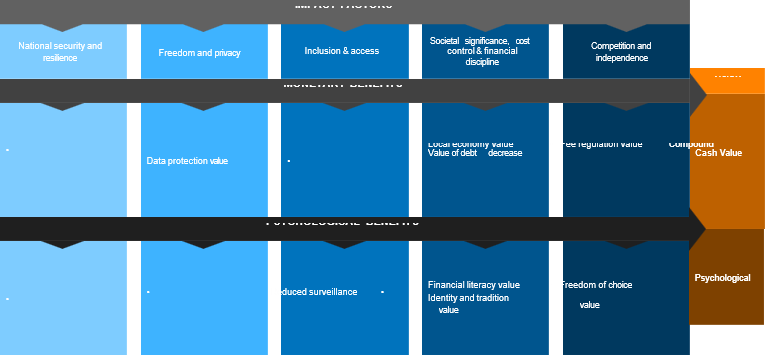
The model identified five areas where cash has an impact:
- National security and resilience;
- Freedom and privacy;
- Inclusion and access;
- Societal significance, cost control and financial discipline;
- Competition and independence.
It then looked at monetary benefits that could be measured for each area, assigning them a compound cash value, and psychological benefits for each area.
The German pilot
For each of the impact areas, three different data sets were collected and compared to assess the compound value added by cash.
At a state level macro data was used, and the researchers had to find a calculation to give an agreed formula to analyse the data.
The second level, described as a business level, used in-depth expert interviews drawn from every stakeholder group across the cash cycle.
Finally, a consumer online survey of 2,000 people, a representative quantitative instrument, addressed the top five topics across the population.
Expert interviews
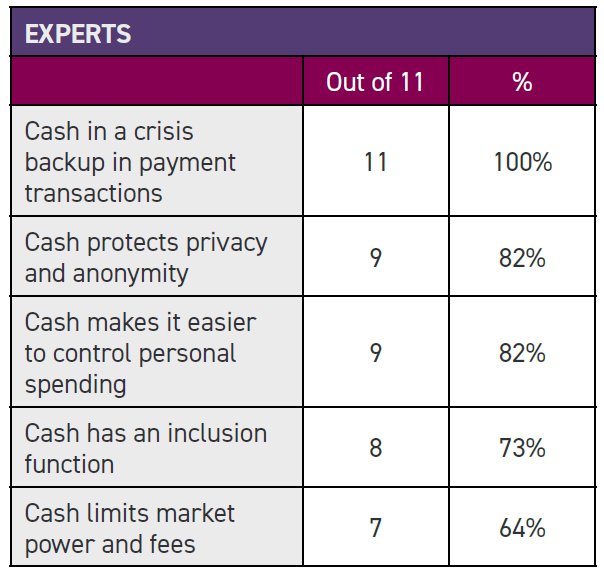
11 experts were interviewed regarding diverse related topics and their level of agreement with a number of statements is summarised below. The results below are where there was broad consensus across the sectors.
Cash in a crisis backup in payment transactions: 11 out of 11 experts (100%). Cash protects privacy and anonymity: 9 out of 11 (82%). Cash makes it easier to control personal spending: 9 out of 11 (82%). Cash has an inclusion function: 8 out of 11 (73%). Cash limits market power and fees: 7 out of 11 (64%).
Survey results
The key survey areas, and the related German survey questions, were:
Resilience – avoiding panic:
- Q: How much cash do you keep at home for emergencies? Answer: €759.
- How much would you recommend others keep? Answer: €995.
Privacy – data protection:
- How much would you pay per digital transaction to ensure your data is not stored or immediately deleted? Answer: €1.35 (median answer, €0.20).
Inclusion – access value:
- How many bank accounts do you have? How much do you pay annually in account fees? Answer: 1% and €58 per year per account.
Cost control – decreasing debt:
- Suppose cash no longer existed. How much more or less would you spend online than you do today? Answer: +12% for consumers under 50. Total population mean +5.6% and total population median +1%.
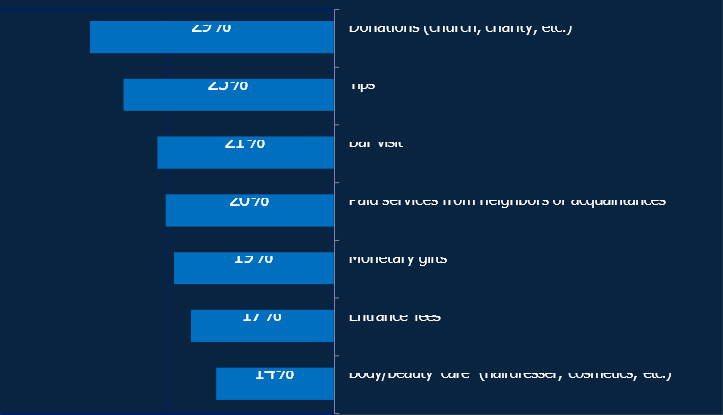
Social significance – local economy:
- Imagine that cash would not be accepted in the following situations.
How would this affect your spending behaviour? Answer:
Independence – fee regulation:
- If cash were abolished, how would this affect the fees of digital payment providers? Answer: +23%. Median +20%.
General perception – significance of cash:
- Does cash have more advantages or disadvantages for society? Does the central bank's cash supply influence your trust in the government? Answer: 66% see more advantage than disadvantage. 36% say it increases trust in government.
Cash value calculation
We are trained to focus on numbers. For each area where cash is relevant, the study considered the:
- Domain, e.g. resilience;
- Impact factor, for resilience value attributed to feeling safe;
- An appropriate formula, e.g. for safety, the recommended cash reserve multiplied by the population. Also included was the consumer surplus value, which is the area under the cash demand curve minus seigniorage;
- Data from appropriate sources. Safety value used survey and central bank data, consumer surplus value is based on seigniorage data from the central bank.
The results were expressed as a percentage of GDP and then added across all monetary dimensions.
The results from the German pilot gave a figure of ≈1.19% of GDP compared with production, distribution and handling costs that came to ≈0.45% of GDP. This result suggests that the value of cash is almost three times higher than the estimated cost of cash in Germany, and the calculations are conservative.
Conclusions
The value of cash can be quantified; also, psychological benefits will soon be captured with clear metrics. Good policy is evidence-led and so this value-framing is important to allow good decisions to be made.
Get the Currency News™ Weekly delivered free to your inbox.