
Royal Dutch Kusters Engineering – Where Banknote Destruction Meets Sustainability

One of the main most visual environmental impacts of banknotes is not in their production but their destruction – with incineration and landfill still being all-too-frequent methods of removal. In last month’s Currency News™, we reported on the results of the 2025 Banknote Recycling Study, the latest biennial survey from Royal Dutch Kusters Engineering (Kusters), which explored how central banks are handling the disposal of unfit notes in particular, and progress made (or not) since the previous survey of 2023.
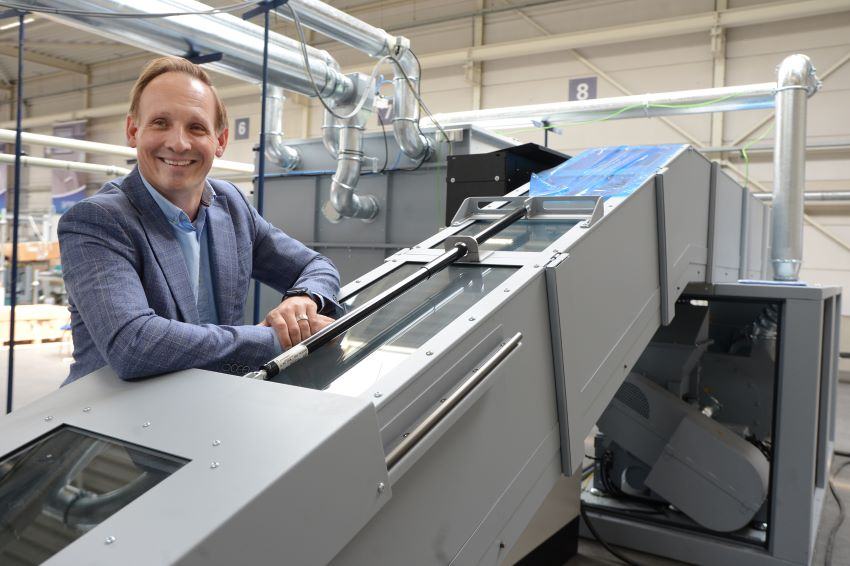
In this issue, we take a look behind the scenes of the company, which this year celebrates its 115th anniversary. We spoke to Jeroen Kusters, its Sales Director and from the fourth generation of family members to work in the business, about the foundations of Kusters, how it was well ahead of its time in identifying and addressing the management and disposal of waste in a secure and sustainable manner, and the challenges of modern day recycling of end-of-life banknotes.
Q: Let’s begin with the origins of the company. How did it all start?
A: The company was established on 9 June 1911, so this year marks our 115th anniversary. My great-grandfather founded the company as a small blacksmith.
He had a modest workshop where he supported people who relied on horses and carriages. That meant producing and fitting horseshoes, repairing wheels, and maintaining the basic infrastructure that transport depended on at the time.
From there, the business gradually evolved into a broader metalworks company. We began producing a wide range of metal components for different industries and customers, moving into the development of recycling solutions in the 1970s.
We started developing solutions to recycle various types of waste, for example machines for recycling chicken litter, converting it into briquettes that could be used as an alternative energy source to generate heat for the same chicken farm. It was an early circular solution.
We also developed systems for recycling glass, coffee pods, and document recycling, and even nuclear waste handling. We even built complete factories to recycle fluorescent light tubes.
Although these applications look very different, they all share a common thread –solutions based on size reduction (shredding), separation, transporting, and compacting. Those four core techniques remain central to our most of our solutions today.
Q: Recycling was not a major priority in the 1970s. What drove that early focus?
A: It came from observing our customers. The third generation of our family, who were running the company at the time, visited clients and noticed that large amounts of valuable material were being discarded.
A good example is a coffee producer we worked with. On one side of the factory, they used our shredder for their general waste. On the other side, they were discarding up to 20% of their coffee pod production due to minor defects – too much or too little coffee, incorrect printing, and so on. All of that material was being thrown away and incinerated.
We questioned that approach. Coffee is an expensive resource, so why throw it away? That led us to develop a machine with the customer that could open the pods, separate the materials, and recover the coffee for reuse. We installed dozens of these systems across Germany, the Netherlands, and Belgium.
At the time, the concept of a circular economy did not really exist, but our company and family clearly had an instinct to reduce waste and recover value.
Q: How did the company transition into the currency industry?
A: The entry point was through secure document destruction. We were supplying shredding systems to organisations such as Shell and some commercial banks like ABN AMRO to destroy their confidential documents.
Based on that technology, we were approached by Royal Joh. Enschedé – formerly the Dutch national printworks until 2010 – with a specific challenge. The company asked us to help develop a more secure solution for shredding misprinted banknotes and printing waste. At the time, these banknotes were transported to incineration facilities, where employees had to supervise the destruction process for hours.
We developed a patented solution for in-house, secure destruction. Once that system proved successful, we began to explore whether other printing works and central banks faced similar challenges. My father attended the first Currency Conference in the late 1980s and presented this technology to the wider industry.
We were already installing systems for institutions such as the Bank of Portugal and the Bank of England, but the response from central banks after that conference was immediate. That was the moment we recognised a clear market opportunity and shortly afterwards decided to focus entirely on banknote destruction, moving away from broader recycling activities.
Q: Was timing a factor in that transition?
A: In the late 1980s, environmental regulations – particularly in Europe – were becoming stricter. Incineration in city centres was increasingly restricted due to emissions concerns. Central banks could no longer operate incinerators in the same way as before.
Our solutions provided an alternative at exactly the right moment – we were there at the right time and place.
Q: How is the company structured today?
A: Our headquarters are in Venlo, in the Netherlands. We are part of a holding group and employ over 300 people globally. In addition to the Netherlands, we have offices in India, the US, Kenya, and the Philippines, primarily focused on sales and service.
Most of our production takes place in the Netherlands. We have installed around 700 machines in more than 85 countries across all continents.
Q: When did you join the company?
A: By the time I joined, 20 years ago, the company had been in operation for 95 years. After completing my studies, I was asked to join and explore new markets. This particularly involved secure document destruction for intelligence agencies and the defence sector, with a focus on the United States.
I initially worked from our headquarters in Venlo, supporting business development. Within a couple of years, I relocated to the US and managed our office in Washington DC, mainly working with US customers on secure document destruction, but also the Federal Reserve Banks, the Bureau of Engraving and Printing and the US Mint.
This was around the time that we realised that we were very dependent as a family business on the currency market (banknotes and coins) alone. We therefore started exploring difference markets, such as secure document destruction, although 99% of our business is still based around banknotes and coins.
I am now the Director of Sales and part of the fourth generation of the family involved in the business. There are four of us from this generation currently working within the company.
Q: Can you outline your current portfolio of solutions for banknotes and coins?
A: We provide a wide range of tailored solutions for handling unfit currency. Depending on a customer’s processes, volumes, substrates, and available space, we custom-design systems to securely destroy unfit currency – either banknotes, printing waste, or coins, and sometimes other secure items such as passports.
We develop, engineer, and produce solutions for that, and install and service those globally. This includes destruction and shred handling (for cotton, polymer, and hybrid substrates) for banknotes, including banknote punching machines to punch holes in the notes prior to their destruction.
Kusters also offers machines for unpacking coins from sachets and rolls, in addition to solutions for the destruction of unfit coins or those that have been withdrawn from circulation.
We also offer service and software solutions to maintain the machines and enable monitoring and reporting. Going back to the beneficial environmental aspect, we carry out upgrading and overhauls of existing machines. We can change machine components so that they run for another 10 or 20 years or adapt them to handle a different secondary substrate, for instance, without the customer needing to buy a more expensive replacement, thus minimising downtime.
Q: How are coins destroyed?
A: We deform them in a process we refer to as ‘waffling’. The coins are pressed into a waffle-like shape, making them unusable in vending machines or circulation. If someone attempts to reshape them, the deformation remains visible. The material can then be sold as scrap metal to the highest bidder.
Q: Do you support customers beyond the destruction process itself?
A: Increasingly, yes. Historically, our focus was on equipment, but we are now exploring ways to support customers with downstream solutions.
This is challenging because each country has different regulations, infrastructure, and economic conditions. There is no universal solution. Over the years, we have experimented with recycling shredded banknotes into products such as benches, tables, and briefcases. When we first explored this, around 35 years ago, there was far less of an interest in recycling and costs were way too high.
Today, interest has increased, but economic viability and scaling up these recycled product solutions remains a barrier. We are working to identify best practices globally and to develop solutions ourselves and with strategic partners that can help customers become more environmentally friendly.
Q: How do different banknote substrates affect your processes?
A: For shredding, the same machines can generally handle cotton, polymer, and hybrid notes with minor modifications. The main challenge lies in volume reduction.
Cotton shreds are fluffy and can be compacted more easily, reducing their volume significantly and therefore transport cost and storage, making them useful as an energy source. Polymer shreds cannot be compacted in the same way as the density is already much higher and briquetting plastics can be a challenge.
Hybrid substrates present the biggest challenge in terms of recycling. When multiple materials are combined, separation becomes more complex and limits recycling options. However, I know solutions are being developed for this too.
For currencies with a mixture of substrates, most of our customers will typically pre-sort the notes. Polymer is treated separately from cotton – they run it on the same machine but in different batches.
Q: Do increasingly complex banknotes create challenges for disposal?
A: Not for destruction – we have not encountered significant issues yet. There’s been a lot of local use materials, differing by each country depending on what they use to produce the banknote paper. Over the last 45+ years or so, we’ve never had any problems in destroying a banknote.
However, complexity does make recycling more difficult. The more different materials and features included in a banknote, the harder it is to separate and reuse them. If everything were made from a single material, recycling would be much easier, but that is not compatible with security requirements and the nature of modern banknotes!
Perhaps one day we will have fully circular banknotes, where you can remove the ink and recycle it into new ink, remove the foils and make new foils, remove the fibres and make a new paper banknote out of it, and so on. Some of these things are already being done by our partners right now.
Q: What key changes have you observed in the industry over the past two decades?
A: One noticeable shift is in the people. The industry has become more diverse, with more women involved, which is a very positive thing. I also think it has become less formal and the demographic is becoming slightly younger. Or maybe I’m just getting older!
Another major change is the adoption of remote communication. Since COVID, online meetings have become standard, whereas previously they were often not even possible. Travelling less is good for the environment, but we also see improved efficiency.
Tendering has also become more common. However, it is not always beneficial to tender for a solution that is purchased only once every 20 or 30 years, compared to those that are bought every year such as banknote paper or inks.
Specifications can vary depending on those provided by the various suppliers, so you may end up with requirements that no one can reach – the so-called ‘sheep with five legs’.
Therefore, everyone has to modify what they have and costs will increase. So, tendering is not always more beneficial for the end user. However, we do see a shift of customers moving away from tendering for this purpose.
Q: What is your perspective on sustainability within the industry? Do you think it is a preoccupation only for the most advanced economies?
A: Sustainability is a global concern, not just a first-world issue. We receive enquiries from all regions. While many organisations express interest and I think generally people want to do something about it, fewer take concrete action. In other words, they are good at talking the talk, but not necessary walking the walk.
The main barriers are cost and the lack of locally available technology or solutions. In many cases, waste disposal decisions at the tendering stage are driven by price.
If landfill is cheaper than recycling, it will often be chosen unless regulations dictate otherwise.
That’s not just in our industry, that’s globally. Waste follows the money. If there’s a cheaper way to get rid of waste, people will find a way to get rid of the waste even if its landfill.
Q: How are shredded banknotes typically handled today?
A: In Europe, ECB regulations require incineration with energy recovery. Outside of that, the majority still ends up in landfill in a lot of places.
There are positive examples – recycling into paper products, use in cement production, composting in countries such as Pakistan, Colombia, and the United States – but these are not yet the majority.
Polymer shreds are more often recycled in many countries as it is easier to mix this with existing recycling efforts.
Q: Are you involved in developing new recycling solutions?
A: Yes. We are working with partners globally, including initiatives in Brazil where briquettes are recycled into new banknote or security paper. We also support customers by connecting them with relevant partners.
On the polymer side, we are developing our own solutions and conducting large-scale tests with real banknotes. We expect to bring new solutions to market in the next few years.
Q: How are you addressing energy efficiency, particularly as energy costs surge?
A: Energy efficiency is increasingly important, both for us and our customers. More organisations are evaluating the total cost of not just the machine, but of energy, maintenance, and staffing.
Our machines incorporate energy-efficient motors and intelligent systems with sensors that adjust performance based on demand. This ensures that energy is only used when necessary.
Q: Finally, what advice for banknote disposal would you give to central banks starting from scratch?
A: Start with the design of the banknote. The choices made at the design stage determine what is possible at the end of life.
It is essential to involve the entire value chain, from designers to recyclers, when developing solutions. Without collaboration, even well-intentioned designs can fail in practice.
One example of this is when plastic butter tubs in the Netherlands were redesigned by the manufacturer. They designed a tub created using one type of material so it was ‘100% recyclable’, but they did not collaborate with those involved in recycling it to ensure that they had technology to detect the new tub and separate it from the waste so it could be recycled.
If we really want to make products that are properly recyclable, we have to work together. I hope that we’ll achieve this in the next 20 years.
More broadly, the industry must work together to ensure that cash remains relevant and cost-effective. Despite ongoing predictions, cash is still widely used globally. There’s never been as much cash in the world as there is today. By focusing on efficiency, sustainability, and system durability, we can make the cost of cash as efficient as possible and ensure it continues to be used.
Get the Currency News™ Weekly delivered free to your inbox.