
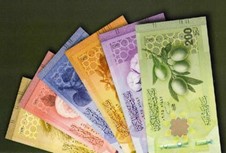
The new banknotes are now denominated in 10, 25, 50, 100, 200, and 500 Syrian pound notes. Then portraits of the former presidents (Basher Assad and his father) have been replaced with images of plants, crops and animals such as such as wheat, olives, oranges, mulberries, roses, and horses, and the overall designs are both modern and colourful, all of which is intended to be both politically neutral and symbolise a break with the past.
The security features common to all the notes are a mould made watermark depicting the Syrian eagle and an electrotype of the denomination numeral, and the HMC (Hidden Multi Color) and MVC (Moiré Variable Color) features combining offset print with embossing that change colour according to the viewing angle. The three highest denominations include what appear to be micro-optics threads in different colours, showing the numeral or the letters SP depending on the viewing angle. The 50, 25, and 10 pounds have diffractive threads in gold, silver and pink respectively.
Whilst the name of the supplier has not been disclosed, it is assumed that it is the Russian state printer Goznak, producer of Syria’s banknotes in the past, owing to the inclusion of the HMC and MVC features, and their Mobile micro-optics thread.
The new and old notes will co-circulate for a period of 90 days, after which the old notes will be withdrawn.
The redesign will cover all the denominations originally planned for issue in 2024, of which only the 10 and 20 Zigs were ever introduced.
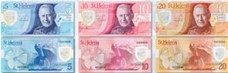
Designed and produced by De La Rue on its SAFEGUARD® substrate, the fronts feature a portrait of King Charles III and part of the nation’s coat of arms: a shield with the St Helena plover (or ‘wirebird’) at the top and a three-masted sailing ship in a mountainous coastal scene. The reverses depict Jonathan the Tortoise – believed to be the world’s oldest living animal, at an estimated 193 years old, resident on St Helena – and the dwarf ebony, a flowering plant endemic to the island.
Security features include clear windows, shimmer effects that become evident on tilt, raised ink and tactile dots, micro-text, and UV fluorescence. The dots, found in the bottom right-hand corner of each note, signify their denomination to assist people with visual impairments.
There remains just one note now to be issued in the new Saka series – the 20,000 tenge – which will be released later this year.
The design incorporates national achievements such as the Oman Botanic Garden on the front, and the Sayyid Tarik bin Taimour Cultural Complex, Duqm Port and Refinery on the rear, celebrating Omani identity.
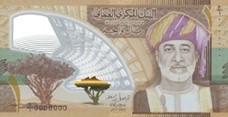
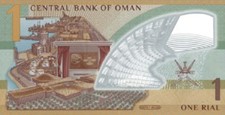
Security features include a large transparent window in the shape of the arched windows of the Botanic Garden – embedded within which is a colour-shifting foil depicting a frankincense tree, a symbol of Oman’s cultural. On the reverse, the images are printed using IRISWITCH® optically variable colour-changing ink, producing a pearlescent effect that shifts with the viewing angle.
The new note is legal tender and will circulate alongside existing notes.
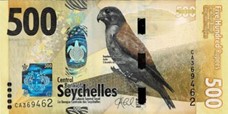
The Optiks thread in the 500 rupee of 2016 was laid over a transparent oval window in which was displayed the Seychelles vinegar fly. The holographic stripe that replaces it depicts a Hawksbill turtle, one of Seychelles’ most recognisable marine species. The turtle appears to move through stylised waves when the note is tilted.
The new note retains the diffractive patch featuring the national coat of arms of its predecessor, but also includes a security thread that changes from red to green when tilted, and depicts small turtles.
When tilted, the numeral ‘500’ become visible. Included within the print design, meanwhile, are Enhanced GEMINI™ and SPARK™.
These include an updated UV fluorescent diffractive stripe from Hueck Folien featuring the Mohéli star and the letters BCC, and the country’s national emblem in SPARK Live®.
The notes, which were produced by Banque de France, will co-circulate with the 2006 notes.
The new design will be introduced into circulation by the end of 2026, with the old designs remaining in circulation.
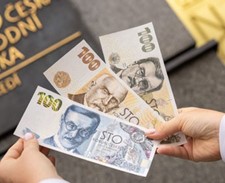
The first note in the series, issued in 2019, featured a portrait of Alois Rašín, Czechoslovakia’s first Finance Minister, and the second, in 2022, Karel Engliš, another Finance Minister and Governor of the Bank. The latest note features a portrait of Vilém Pospíšil, the CNB’s first Governor.
The banknote, which was printed by STC, includes two types of watermark, a security thread, microtext, and latent image. The denomination numeral appears in SPARK® Flow
The print run was 20,000 notes.
The notes were printed by Crane Currency and include a RAPID® HD Detect thread (as do the 100 and 500 lempiras), along with watermark, fibres, colour-changing ink and fluorescence. 20 million of the notes were produced.
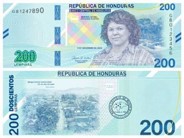
The 200 lempira was first issued as part of a commemorative series marking the bicentennial of Honduran independence. Before then, the two highest denominations were the 100 and 500 lempiras respectively.
This is the first redesign since 2001, and the new notes will start going into circulation some two and a half years after the final theme selection.